
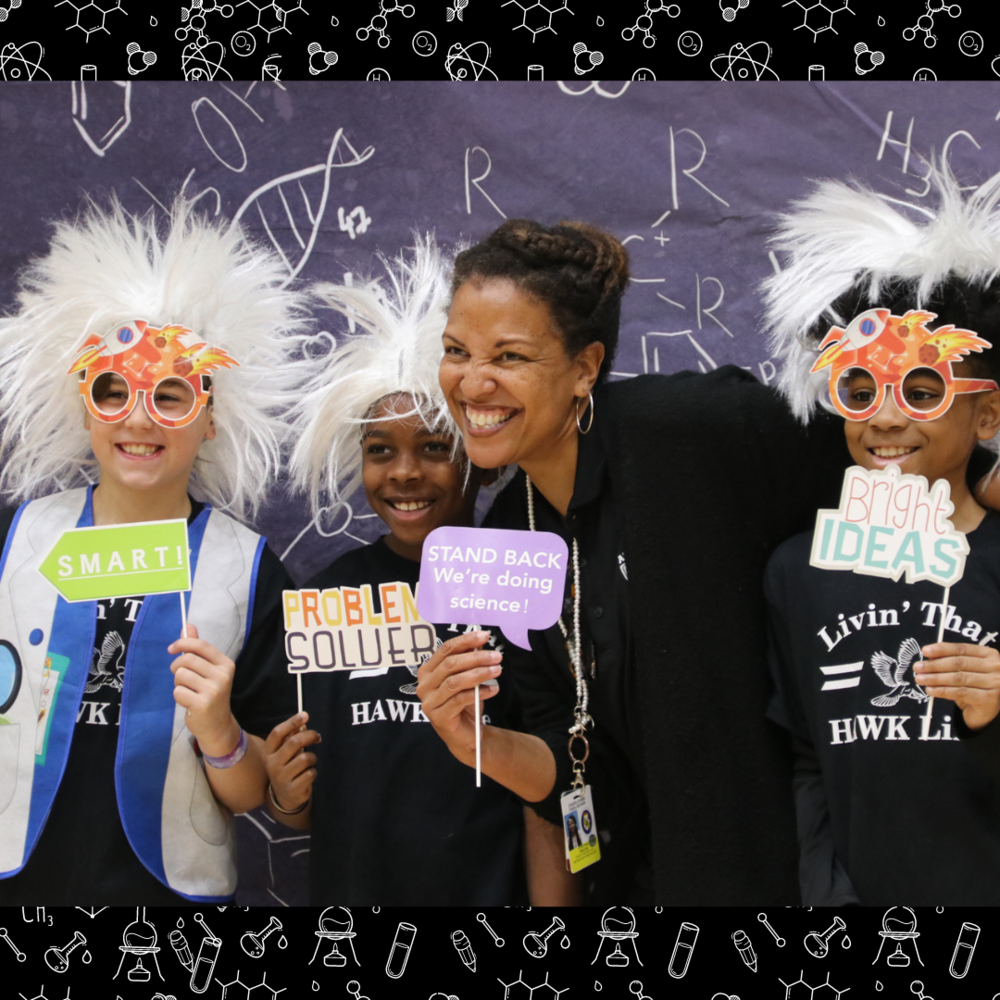
Charles County Public Schools (CCPS) students active in Mathematics, Engineering, Science, Achievement (MESA) clubs at their elementary, middle and high schools competed April 5 at the MESA Regional Showcase and Awards Ceremony.
The first-place awardees at the event move on to the MESA state competition May 4 at the John Hopkins Applied Physics Laboratory in Laurel.
There are five challenges in the MESA showcase — the Storybook Theme Park Ride Challenge, the Community Clean Up Challenge, the Planetary Lander Challenge, the Wearable Technology Challenge and the National Engineering Design Competition.
The Storybook Theme Park Ride Challenge is limited to elementary students and tasks students to learn the engineering design process while applying physics to design and build a functional model of a theme park ride based on a storybook. The ride must safely carry four passengers — a marble, two ping pong balls and a golf ball — through two consecutive test runs.
The Community Clean Up, Planetary Lander and Wearable Technology challenges were open to all three levels — elementary, middle and high schools.
Community Clean Up called for teams of students to design a Super Clean Machine, an automated system that can generate its own power from the sun, wind or water to clean the environment. It had to have a moveable conveyor belt to carry trash to a collection container and collect waste from land, water or both.
The Planetary Lander asked MESA clubs to put their heads together to design a lander that would allow astronauts (ping pong balls or other lightweight stand ins accepted) to touch down successfully on another world. The final design needed to be as light as possible while protecting the “astronauts” during landing. The lander had to be made of components that fit entirely inside a transport container of a specified size. Kenzo Evans, a fifth-grade student at Mary B. Neal Elementary School, helped his team think up the design of their lander. He enjoys being in MESA because it’s fun and he gets to be creative. “Even though it’s challenging sometimes, I find it satisfying and rewarding,” he said. “We worked so hard to get this right.”
The Wearable Technology Challenge was one centered on wearable medical devices and technology. Teams designed, built and demonstrated a wearable device to monitor a specific indicator of health in infants.
Middle and high school MESA clubs could tackle the National Engineering Design Competition (NEDC). Teams had to use a coding component as the main part of the design. Teams must use the United Nations Sustainable Development Goals in a community-centered capacity for the project.
Teams had to identify an issue dealing with inequity, then engineer a solution, develop a prototype and present the fix. A team from Benjamin Stoddert Middle School developed a tool that would alert drivers when a car’s temperature exceeded a certain degree if it had a child’s safety seat in the vehicle. The purpose was to keep children from passing away in vehicles from heatstroke. Grace Niranoluwa, a sixth-grade student who worked on the design, said she liked participating in MESA because she enjoys working with computers. “I think more girls and women should be into engineering and stuff like that,” she said. “It could lead to a lot of different ideas and ways of thinking.”
At the regional competition, Mamta Patel Nagaraja, the NASA Associate Chief Scientist for Exploration and Applied Research in the Office of the Chief Scientist, was the keynote speaker. Nagaraja advises the chief scientist and is interested in increasing diversity and inclusivity in science.
The following teams placed at the elementary-school level:
Storybook Theme Park Ride Challenge
William A. Diggs Elementary School, first place.
Malcolm Elementary School, second place.
Dr. Thomas L. Higdon Elementary School, third place.
Community Clean Up Challenge
Berry Elementary School, first place.
Diggs, second place.
Mt. Hope/Nanjemoy Elementary School, third place.
Planetary Lander Challenge
Malcolm, first place.
Diggs, second place.
Berry, third place.
Wearable Technology Challenge
Diggs, first place.
Dr. Samuel A. Mudd Elementary School, second place.
Malcolm, third place.
The following teams placed at the middle-school level:
Community Clean Up Challenge
Piccowaxen Middle School, first place.
Benjamin Stoddert Middle School, second place.
Matthew Henson Middle School, third place.
Planetary Lander Challenge
Mattawoman Middle School, first place.
Henson, second place.
Piccowaxen, third place.
Wearable Technology Challenge
Davis, first place.
Piccowaxen, second place.
Stoddert, third place.
National Engineering Design Competition (NEDC) Challenge
Piccowaxen, first place.
Davis, second place.
Stoddert, third place.
The following teams placed at the high-school level:
Planetary Lander Challenge
St. Charles High School, first place.
La Plata High School, second place.
North Point High School, third place.
Wearable Technology Challenge
Henry E. Lackey High School, first place.
NEDC Challenge
La Plata, first place.
North Point, second place.
About CCPS
Charles County Public Schools provides 27,765 students in grades prekindergarten through 12 with an academically challenging education. Located in Southern Maryland, Charles County Public Schools has 38 schools that offer a technologically advanced, progressive and high quality education that builds character, equips for leadership and prepares students for life, careers and higher education.
The Charles County public school system does not discriminate on the basis of race, color, religion, national origin, sex, sexual orientation, gender identity, age or disability in its programs, activities or employment practices. For inquiries, please contact Kathy Kiessling, Title IX/ADA/Section 504 Coordinator (students) or Nikial M. Majors, Title IX/ADA/Section 504 Coordinator (employees/ adults), at Charles County Public Schools, Jesse L. Starkey Administration Building, P.O. Box 2770, La Plata, MD 20646; 301-932-6610/301-870-3814. For special accommodations call 301-934-7230 or TDD 1-800-735-2258 two weeks prior to the event.
CCPS provides nondiscriminatory equal access to school facilities in accordance with its Use of Facilities rules to designated youth groups (including, but not limited to, the Boy Scouts).